Product management podcasts - September 2026
By Ross Stanley ·
Here’s a round-up of the best product management podcasts from September, including from the Lenny & Friends Summit hosted by Lenny Rachitsky in San Francisco, CA.
Roles aren’t converging—they’re expanding | Tamar Yehoshua (Atlassian CPO)
Lenny’s Podcast · 29 September 2026
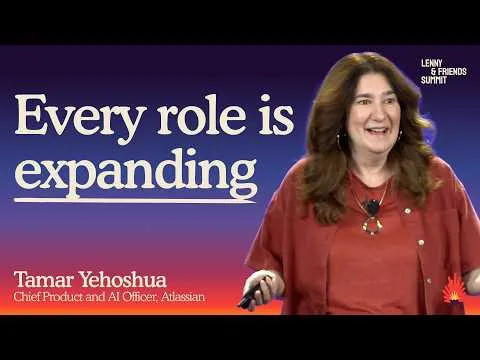
Tamar Yehoshua, Chief Product Officer at Atlassian, explains that product manager roles are expanding with AI integration rather than converging. She illustrates how PMs combine coding, prototyping, and steering to accelerate product development and improve team throughput using AI tools and organizational context.
In their own words
“Roles in product teams are overlapping and expanding rather than converging or disappearing due to AI.”
- Tamar Yehoshua · 0:59
“PMs have a ‘front row seat’ in how AI and tools accelerate team workflows.”
- Tamar Yehoshua · 4:30
Key takeaways
- Product manager roles in startups are merging multiple functions into ‘AI builder’ roles combining product management, design, and engineering, while in large enterprises like Atlassian, PM roles evolve with AI without disappearing.
- AI tools automate routine coordination tasks such as note taking and launch tracking, enabling PMs to focus on accelerating team velocity by integrating AI intelligence with organizational context graphs.
- PMs flexibly adapt between hands-on coding ‘rowing’ to unblock teams and strategic ‘steering’ to set direction, exemplified by Atlassian PMs who write code and prototypes early to facilitate faster iteration cycles.
- At Atlassian, AI-assisted development shortened new AI feature launches to 6 - 8 weeks from about 6 months, with Jira increasing throughput threefold using AI agents for prototyping, bug fixing, and triaging customer feedback.
- Atlassian developed an AI fluency index covering tool use, prototyping, technical literacy, and other skills, plus quarterly AI builder weeks to train over 1000 PMs, aiming for skill growth and AI native product management.
- Measuring AI fluency impact includes tracking pull requests deployed, feature delivery rates, cycle times, and OKRs, though precise metrics remain challenging; continuous experimentation informs effectiveness.
- PMs maintain traditional goals of product-market fit, customer love, and business viability, but achieve them through new AI-enabled methods, reflecting an expanding rather than contracting role for PMs.
Four questions to ask before building AI into your product — Kendra Vant (Chief Product Officer, Tapi)
The Product Experience: a Mind the Product podcast · 30 September 2026 | 44:05

Kendra Vant, Chief Product Officer at Tapi, highlights the hidden workload users perform to make AI products feel reliable and urges product teams to explicitly design and own this reliability layer. She emphasizes planning for AI failure modes, cost implications of scaling, and the evolving role of technical literacy in product management.
In their own words
“The ability to call bullshit on the tool is the real product judgment.”
- Kendra Vant · 36:30
“I spend 11 years training as a scientist, and science teaches you to break down really big problems into smaller problems.”
- Kendra Vant · 41:00
Key takeaways
- AI demos often hide the critical question of who owns the reliability layer - whether users, product, or engineering - to catch and fix AI errors during real use, a necessary step to move beyond prototype to product. (17:00)
- End users typically perform unpaid correction work - adjusting prompts, spotting mistakes - to maintain AI reliability, but most are neither motivated nor expert enough to do this consistently, challenging assumptions about AI product usability.
- Building a reliability layer entails significant engineering and operational costs including human review, guardrails, and multiple model usage; these costs can surpass product revenue as usage scales, raising sustainability concerns.
- Product teams must plan explicitly for AI failures with fallback or recovery strategies to maintain customer trust, as stating failure rates candidly reframes expectations and prepares users for imperfection.
- Product managers do not need to code fully but require strong technical literacy - including familiarity with Git and codebases - to collaborate effectively with engineers and leverage AI tools efficiently.
- Experienced product teams hold an advantage in judging and filtering AI outputs accurately, highlighting the importance of product judgment - ‘the ability to call bullshit on the tool’ - which may be challenging for newcomers in the AI era.
- Writing down answers to complex questions and explaining them to colleagues improves problem clarity and exposes gaps in AI product assumptions, a practice superior to querying AI which tends to affirm user errors.
Marty Cagan: Strong Opinions, loosely held
Lenny’s Podcast · 26 September 2026
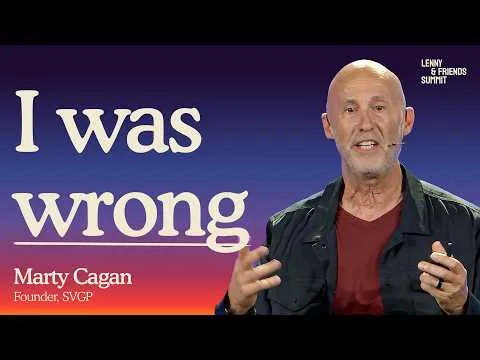
Marty Cagan, product expert and author of Inspired, reflects on the evolution of product management, emphasizing the critical need for humility, strong product leadership, and a balanced focus on both problem and solution discovery in an AI-driven landscape. He highlights how rigid predictability and overreliance on process can hinder true innovation and outcomes.
In their own words
“In many companies, process is used as a substitute for thinking.”
- Marty Cagan · 20:00
Key takeaways
- Product management must solve real customer problems and deliver business outcomes rather than focusing narrowly on processes or tooling, preserving durable principles but re-examining them in the AI era.
- Business viability is a core product risk often underestimated; it requires ensuring demand and sustainable operational integration including marketing, sales, legal, and ethics, especially challenging for AI products.
- True innovation arises from solution discovery as much as, or more than, problem discovery, as many product failures stem from competitors delivering better solutions rather than lack of demand.
- Humility - acknowledging what you do not know - is vital for product success and conflicts with outdated notions like product managers being CEOs of their product.
- A desire for predictability drives reliance on rigid roadmaps and PRDs, which can stifle innovation; these artifacts should be used post-validation as communication tools, not as fixed plans.
- Strong product leadership is essential to empower teams effectively by providing clear strategy, context, and prioritization; without it, even empowered teams may struggle.
- AI amplifies the need for critical thinking, focusing on outcomes over outputs, and balancing building to learn (discovery) with building to earn (delivery).
AI in Product Management: Lessons from Pawana Burlakoti
Productside Stories · 29 September 2026 | 22:45 | S5 E4

Pawana Burlakoti, a Product Management Executive, shares actionable insights on embedding AI into product teams and hiring for strong product sense in the evolving AI landscape. She also advocates unifying product and UX functions to enhance customer experience and accelerate innovation.
In their own words
“A teammate built a best-practice repository in a single evening that used to take months.”
- Pawana Burlakoti · 10:00
“AI-mature product managers don’t exist yet; I hire for strong product sense and look for those who’ve built something with AI because they couldn’t help themselves.”
- Pawana Burlakoti · 13:30
Key takeaways
- AI adoption is embedded as a core team objective, with every group tasked to learn, experiment, and share AI applications that speed product workflows, such as automating jobs-to-be-done mapping and prototyping.
- There are no truly AI-mature product managers yet; hiring focuses on candidates with strong product sense who self-initiate AI projects out of curiosity and can demonstrate real AI-built products.
- Integrating UX teams under product management creates a unified voice for clients and allows ongoing discovery and delivery without conflicting agendas, thus strengthening collaboration and client communication.
- Identifying shared capabilities across a product portfolio, like data ingestion and compliance, lets teams develop foundational components once, reducing customer friction and enabling seamless product expansion.
- Empowered product teams are grown through coaching and enabling early-career PMs to lead without people management duties, balancing leadership across business, engineering, and customer needs with continuous domain learning.
Context is now the product: Product leadership when software can build itself | Karri Saarinen
Lenny’s Podcast · 30 September 2026
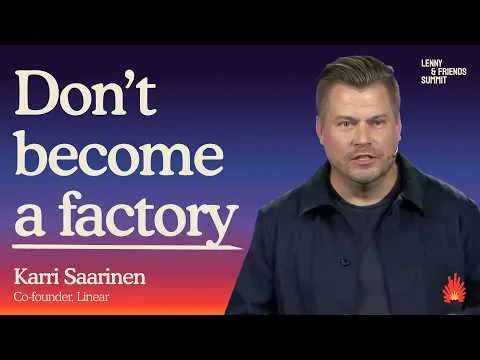
Karri Saarinen of Linear explores how AI reshapes product leadership by shifting focus from code output to building shared customer context, team learning, and judgment. He emphasizes that great products arise from deep understanding and collaborative critique, with AI augmenting insight rather than replacing human intuition.
In their own words
“Context becomes the product.”
- Karri Saarinen · 16:00
Key takeaways
- Advances in AI and software tools do not guarantee better products or improved team judgment, as faster output alone misses what customers truly need. (1:00)
- Focusing on scaling software output through specialization risks losing sight of the real value creators: understanding customer problems and delivering solutions, not just lines of code. (2:00)
- Product creation generates two outcomes: the product itself and deeper learning about customers; great teams cultivate this learning through shared context and continuous reflection. (3:30)
- AI can automate repetitive tasks like bug fixing, freeing engineers’ time, but saved time should be reinvested in customer engagement to strengthen team intuition and judgment. (7:00)
- Without deliberate processes, AI tools can fragment knowledge, creating silos; fostering collaborative practices like feature critiques and quality reviews ensures collective learning. (10:30)
- Linear’s practice of daily AI-summarized customer briefings and weekly ‘quality Wednesdays’ enhances team connection to customer needs and collective product quality awareness. (9:00)
- Product leadership will increasingly depend on managing and learning from accumulated customer context rather than solely on code execution and feature delivery. (17:00)
- Hiring priorities should emphasize candidates’ capacity for judgment, ideas, and learning trajectory over mere ability to increase output. (16:30)
The grief, loneliness, and burnout sweeping through the tech industry right now | Molly Graham
Lenny’s Podcast: Product | Career | Growth · 28 September 2026 | 1:34:14

Molly Graham, leadership expert and TED’s WorkLife podcast host, discusses the profound grief, loneliness, and burnout currently affecting the tech industry amid rapid AI adoption. She revisits and nuances her “Give Away Your Legos” advice, emphasizing selective delegation to AI, managing emotional impacts, and evolving leadership in this transformative era.
In their own words
“Change sucks. It also can be awesome, but we don’t have to be fluffy bunnies about this. We can also just say this is hard.”
- Molly Graham · 22:00
“Think about AI as an intern: what would you give to an intern and what would you never give them?”
- Molly Graham · 1:30:00
Key takeaways
- Molly Graham’s original “Give Away Your Legos” advice, advocating delegating tasks during rapid growth for new opportunities, must be reconsidered in the AI era since delegating to AI still requires human oversight and accountability, making it fundamentally different from delegating to humans.
- Engineering roles are shifting from hands-on coding (‘rowing’) to managing AI agents (‘steering’), causing grief as professionals lose familiar identities and face loneliness due to less team collaboration and more AI interaction.
- The fear narrative that AI will imminently eliminate jobs is overblown and toxic; layoffs labeled AI-related often reflect poor management rather than AI displacement. Instead, AI will transform jobs; continuing learning and adaptability are key to thriving.
- Despite a 55% burnout rate among tech workers (up from 44%), about half report being the happiest in their careers, notably those in smaller teams or feeling amplified by AI, illustrating complex emotional responses to current AI-driven changes.
- Delegating tasks to AI imposes a continuous cognitive and emotional burden as AI operates like a ‘lazy intern’ needing close coaching and quality control, increasing mental tax and risking burnout despite productivity gains.
- Good management is more critical than ever during AI-driven change. Managers must openly acknowledge grief and anxiety, role model responsible AI use, and create standards for accountability to help employees feel seen and supported.
- Some tasks and projects should never be delegated to AI, especially those requiring judgment, trust, or strategic vision. Humans must maintain leadership roles directing vision while AI supports mid-level functions.
- Accepting grief over lost work identity and tasks to AI is vital. This emotional processing (‘holding funerals’) should be coupled with curiosity about new opportunities AI enables, recognizing that change is complex and not solely positive.
- The most important skill now is habitually questioning ‘Can AI help me with this task?’ while remaining ambitious and breaking down rigid role silos to amplify human creativity and collaboration in evolving workflows.
- The current phase of AI adoption is a ‘slow takeoff,’ giving individuals and organizations time to learn and adapt. Early AI adopters gain advantage, and a balanced realistic view counters alarmist job loss fears.
The rise of HI-ICs | Elena Verna (Lovable)
Lenny’s Podcast · 29 September 2026

Elena Verna, Growth Lead at Lovable, discusses how AI enables high impact individual contributors (HI-ICs) to drive business outcomes independently without managing teams, advocating for organizational designs and career paths that decouple impact from headcount to empower skilled builders.
In their own words
“Impact now depends on how much you can ship and execute independently, not the size of your team.”
- Elena Verna · 2:30
“Management should be a career choice, not the default promotion path.”
- Elena Verna · 19:00
Key takeaways
- Traditional career ladders linking greater impact with managing more people are obsolete; impact depends on shipping and executing independently in the AI era. (2:30)
- High impact individual contributors own problem finding, decision making, execution, and outcomes across functions, expanding beyond narrow expertise. (3:30)
- AI equips individuals with average skills across functions, enabling them to combine one or two exceptional specialties with ‘good enough’ abilities elsewhere for rapid product delivery. (4:30)
- When building costs drop below coordination costs, organizations must redesign to leverage HI-ICs efficiently or risk losing advantage from AI-driven productivity. (6:00)
- High impact IC roles require autonomy, direct access to information, authority with accountability, and a culture that tolerates failure for learning. (12:00)
- To be impactful, individuals need unrestricted information flow and trust rather than traditional gated hierarchies. (12:11)
- Lovable exemplifies flat structures with no traditional managers, using team-specific Slack agents to ensure equality and direct information access. (12:30)
- Pay and status should be driven by impact, not managing headcount; HI-ICs can and should earn as much or more than managers. (14:30)
- Most people managers prefer returning to individual contributor roles, indicating misalignment between title-based promotion and personal fulfillment. (16:00)
- Management requires current experience in individual contributor work that is rapidly evolving, making combined manager-IC roles difficult and inefficient. (16:30)
- The AI era enables rethinking growth by scaling personal craft and leadership without people management, giving individuals renewed career energy and ownership. (17:30)
Rich Mironov: AI Should Change Product Management… Just Not The Way You Think
One Knight in Product · 18 September 2026 | 1:01:36 | S1 E275
Rich Mironov, longtime product management consultant and founder of Mironov Consulting, argues that while AI can speed software development dramatically, it does not automatically increase revenue or market size. Product management must focus more on commercial strategy, market realities, and customer value rather than just faster delivery.
In their own words
“If we squeeze the middle and say engineering doesn’t need us 60% of the time, we shrink that down to 20% and leave 80% for value-add at the edges.”
- Rich Mironov · 40:01
“Money isn’t the same as code; faster building by engineering does not automatically translate to more revenue without corresponding sales and marketing efforts.”
- Rich Mironov · 48:30
Key takeaways
- Faster software development enabled by AI increases code output but does not proportionally grow customer budgets or market size; more products compete for the same fixed market money, intensifying price competition rather than expanding revenue.
- Product managers must prioritize communicating in terms of financial outcomes rather than technical quality or user joy, aligning their focus with executive revenue goals instead of idealized product processes. (5:30)
- Although AI can generate code 10 to 50 times faster, delivered code often lacks commercial-quality attributes like security, usability, and enterprise-grade reliability, limiting real-world product viability. (8:00)
- Shipping many new features overwhelms users, shifting prioritization burden onto customers who can only discover a few updates; product teams must decide what truly matters to build and promote. (21:30)
- Directly implementing all customer requests risks bloated, low-value products; roughly two-thirds of user requests are bad ideas or harmful and must be filtered strategically. (24:30)
- The role of product management is shifting toward a ‘barbell’ model: less time coordinating daily engineering and more time spent on upstream discovery and downstream go-to-market activities. (37:00)
- Organizational incentives often reward product managers for visible coding or AI token usage, pushing them towards tactical tasks rather than high-value strategic activities. (34:30)
- Real gains from AI transformations require organizational workflow redesign and identifying true bottlenecks; merely mandating AI tool use or counting usage hours does not yield success. (19:00)
- Increased development speed demands sales and marketing alignment to commit to selling more products and growing quotas; without this commercial buy-in, faster delivery will not generate revenue. (49:00)
What it takes to be a top PM today | Robby Stein (Google Search)
Lenny’s Podcast · 29 September 2026
Robby Stein, Google Product Manager leading AI Search, highlights that top PMs today excel by making great decisions through deeply understanding user needs, diagnosing root causes in products, and refining details to deliver delight. He emphasizes AI’s role in scaling qualitative insights and quality assurance.
In their own words
“The core craft of product management today is about making great decisions and exercising good judgment.”
- Robby Stein · 3:00
“We built Instagram Stories only after diagnosing audience concerns and enabling ‘Close Friends’ sharing, which unlocked user behavior.”
- Robby Stein · 10:00
Key takeaways
- Product management’s core craft is making great decisions using good judgment, beyond just managing tasks, essential for succeeding today. (3:00)
- Understanding the deep ‘job to be done’ - the real user need behind product use - is critical for making truly lovable products. (4:00)
- AI enhances product insight processes by enabling large-scale qualitative interview scaling and text analysis to accurately define user problems. (8:30)
- Diagnosing root causes of product underperformance leads to iterative fixes, likened to model training, steadily pushing toward product-market fit. (9:00)
- Early AI chatbots failed because text-only descriptions couldn’t inspire choices; integrating multimodal understanding with visuals significantly improved user inspiration. (6:30)
- Combining rich, reliable structured data like maps and ratings with AI conversational search creates a magical and popular user experience. (7:30)
- Craftsmanship involves flawless product operation without frustration and adding delight through subtle motion, color, and design details conveying product humanity. (14:30)
- The updated Google search box uses a color-gradient cursor cycling through Google’s colors, an intentional design detail that delights users and conveys AI presence. (16:00)
- The PM role in the AI era means deeply understanding user needs, analyzing product issues, building simple reliable products, and delivering delight, requiring elevated decision-making skills. (18:00)
- Product creators should focus more on real human needs and less on flashy features or tech to create meaningful product experiences. (19:00)
Why Claude can’t be your PM (yet) | Anthropic CPO Panel
Lenny’s Podcast · 30 September 2026

Ami Vora, Anthropic’s CPO, and Mike Krieger, Instagram co-founder, explore AI’s profound impact on product management, emphasizing that human PMs remain indispensable for problem solving, decision making, and coordination despite rapid AI advances. They discuss evolving roles, agent-native software, and experimental product strategies in AI’s fast pace.
In their own words
“Claude is not yet able to act as a convenor to fully replace human PMs who uniquely bring people and systems together to get work done.”
- Ami Vora, Anthropic CPO · 5:00
“Successful PMs in the AI era throw away prior assumptions about their roles every few months and experiment to figure out what works.”
- Ami Vora, Anthropic CPO · 9:30
Key takeaways
- Product managers must act as essential bridges between human problems and rapidly changing technology, requiring persistent problem solving and iteration amid fast AI-driven cycles. (0:30)
- Despite powerful AI models like Claude, human PMs uniquely convene people and systems to drive coordination, decision making, and follow-through that AI cannot yet fulfill. (5:00)
- The role of PM is evolving to embrace experimentation and discarding prior assumptions every few months to adapt to new AI capabilities and uncertain directions. (9:30)
- Agent-native software will empower agents to modify interfaces dynamically, enabling emergent behaviors and personalized, continuously evolving user experiences. (13:00)
- Anthropic uses Claude internally to dynamically generate and update user interfaces in real time, demonstrating early shifts to AI-driven, adaptable UI creation. (14:00)
- Running many parallel product experiments and integrating them into a coherent, low-cognitive-load user experience is critical; prioritizing the primary user journey avoids feature clutter. (25:00)
- Successful AI-era PM leadership requires clear decision responsibility, framing chaos safely, and high operational excellence to balance rapid change with user focus. (11:00)
- Teams must remain open to revisiting previously failed experiments as AI model capabilities improve to avoid prematurely discarding promising ideas due to current limitations. (24:00)
Toast VP of Product on Building Agents Into Pre-AI SaaS; Shipping AI Into a 14-Year-Old Platform and Building for the Real Economy
The Product Podcast · 26 September 2026 | 30:45
Maggie Crowley, VP of Product at Toast, shares how she leads the integration of AI agents into a mature SaaS platform serving restaurants with razor-thin margins, emphasizing practical AI solutions that improve operator workflows and drive real economic impact. The episode explores the challenges of AI onboarding, user context sensitivity, and delivering strong ROI through AI-driven marketing and operational automation.
In their own words
“Restaurant operators have zero tolerance for ‘AI for AI’s sake.’ They only care whether you helped them run their business.”
- Maggie Crowley · 4:00
“You have to bring the AI to your customer or user; you cannot assume they will discover it on their own.”
- Maggie Crowley · 8:00
Key takeaways
- Toast’s AI adoption focuses strictly on practical value for restaurant operators, who have zero tolerance for ‘AI for AI’s sake,’ requiring AI features to clearly help run their business better. (4:00)
- Integrating AI into Toast’s 14-year-old platform demanded maintaining a high quality bar and convincing users to change entrenched workflows, ensuring user trust was not broken. (5:00)
- Toast began AI product development by iterating with about 10 design partners using WhatsApp groups, a scrappy approach allowing rapid feedback and refinement before broader rollout. (7:00)
- AI onboarding is a critical unsolved challenge; users often do not discover AI features independently, so products must actively bring AI to users, educate them, and re-onboard as features evolve. (8:00)
- Successful AI products rely heavily on understanding user context such as location, time of day, and role to tailor prompts and interfaces that reduce barriers and increase adoption. (10:00)
- ToastIQ Grow has enabled customers to cut marketing agency costs by over 70%, offloading disliked marketing tasks via AI-driven outreach and directly tying marketing efforts to sales outcomes. (18:00)
- Toast abstracts AI model selection (Anthropic, OpenAI, or open weights) away from users so customers can focus solely on business impact without technical complexities. (20:00)
- Maggie Crowley manages her team closely and stays embedded in frontline AI product development to understand evolving workflows and keep pace with rapid AI-driven changes. (21:30)
What product looks like when coding is solved | Geoff Charles (Ramp CPO)
Lenny’s Podcast · 26 September 2026
Geoff Charles, Chief Product Officer at Ramp, explores how AI transforms product development by identifying and removing bottlenecks across the entire process - from problem discovery to coding and shipping. He emphasizes evolving product management roles and optimizing the build ecosystem over just coding faster.
In their own words
“You will know you are moving fast enough if you hire a driver who knows what true speed means and put them in charge.”
- Unknown speaker · 15:00
“The best Ferrari ever made is the next car. The best product you will ever make is the next product you launch.”
- Enzo Ferrari, quoted by speaker · 19:00
Key takeaways
- Winning in complex systems, like racing or product development, depends on removing bottlenecks rather than merely increasing effort; modern racing pit stops exemplify how specialized technology and training reduce process times dramatically.
- Approximately 90% of software code changes yearly, reflecting a rapid continuous evolution comparable to Formula 1 car parts replacement every season. (2:00)
- AI shifts bottlenecks instead of eliminating them; top teams identify and remove new bottlenecks rapidly to accelerate delivering customer solutions from problem identification through shipping. (2:30)
- Ramp uses AI agents integrated with company data to unify and clarify customer feedback at scale, enabling precise problem identification and targeted customer engagement instead of broad outreach.
- Ramp’s AI agent ‘Glass’ connects internal systems to define product requirements precisely, acting as a strategic thinking partner for product managers by answering technical feasibility and risk questions.
- The programming AI agent ‘Inspect’ enables even non-engineers to produce reliable production code, powering about 75% of Ramp’s pull requests, highlighting democratized coding.
- Ramp’s automated QA agent ‘Testo’ simulates user interactions across configurations, detecting hundreds of errors before customers encounter them, dramatically improving quality and speed.
- Product management bottlenecks from coordination and shipping are addressed by ‘Gadget’, an AI assistant that autonomously answers 85% of PM questions, updates roadmaps, manages responsibilities, and even drafts customer communications.
- Automating repetitive product management tasks allows humans to focus on strategic issues, enabling rapid resolution of 60% of UX problems within 24 hours through lightweight Slack interactions.
- Geoff Charles foresees product management roles evolving into three types: technical PMs removing organizational bottlenecks; tastemakers defining product excellence beyond AI; and general managers overseeing business outcomes. (17:00)
- True speed in product development arises from continuously identifying and removing bottlenecks system-wide, not merely faster coding; success means empowering leaders versed in what speed truly entails.
Things You Should Never Hand to AI
Lenny’s Podcast · 29 September 2026

Molly Graham, Founder of Glue Club, explains that tasks involving human judgment, trust, and defining what is good must remain with humans rather than AI. She warns CEOs against trusting AI-generated strategies without their own critical evaluation.
In their own words
“In AI land, I think there are some Legos that shouldn’t be given away.”
- Molly Graham
Key takeaways
- Tasks demanding human judgment and trust naturally belong to humans and should not be delegated to AI, emphasizing the irreplaceable value of human discernment.
- CEOs should not rely solely on AI to generate business strategies but must apply their own critical judgment to those outputs.
- Outsourcing relationship-building tasks that require trust to AI is inappropriate because it undermines essential human connections.
How to scale intent, quality, and artistry with Al | Katie Dill (Stripe)
Lenny’s Podcast · 26 September 2026

Katie Dill, Vice President of Design at Stripe, explores risks and opportunities AI brings to product design, emphasizing the need for clear brand intent, editorial rigor, and human curation to avoid uniform, generic user interfaces and to foster creative originality and quality.
In their own words
“A system can obey all the rules and still be dead.”
- Christopher Alexander · 12:00
“One thing that annoys us about bad AI is the feeling that details don’t matter.”
- Nabeel Qureshi · 15:00
Key takeaways
- Post-World War II modernist architecture inspired many buildings with simple geometries but repeated without intentionality, resulting in generic ‘zombie’ buildings lacking context and care. (1:00)
- The current AI-fueled building boom risks repeating this pattern in digital products, producing generic, lifeless ‘zombie UIs’ that lack differentiation and user focus. (4:30)
- Large language models often generate probable, common answers, neglecting authentic, brand-specific, or user-contextualized solutions, risking loss of personality in products. (2:30)
- Design teams must embed a clear point of view and brand alignment into AI usage to produce outputs consistent with unique vision and user context. (6:00)
- Encoding design standards directly into production systems and AI workflows is critical for maintaining distributed, automated, and consistent product quality beyond manual control. (9:00)
- Editorial oversight is essential post-AI output; editors must evaluate products holistically for coherence, completeness, and true user impact beyond superficial polish. (13:30)
- AI expands creative possibilities but cannot replace human care, iteration, and the pursuit of subtle, meaningful design details that resonate with users. (16:00)
- Leaders should foster team culture that protects explorations of unique, unusual ideas rather than defaulting to safe, conventional AI-generated patterns to unlock originality. (19:30)
Taste Is What You Refuse to Ship
Lenny’s Podcast · 25 September 2026

This episode explores Evan Spiegel’s distinctive product leadership style, emphasizing the critical role of taste and discipline in what consumer startups choose to ship. It highlights how effective product leaders, like museum curators, lean on stringent selection and refusal of ideas to craft their offerings.
In their own words
“If a museum has all of their collection on the walls, then the curator hasn’t done anything.”
- Unattributed speaker reflecting on Evan Spiegel’s approach · 0:30
Key takeaways
- Evan Spiegel’s ability to reject better ideas than most consumer startups actually launch underscores his exceptional product taste and discipline, crucial qualities in product leadership.
- The best product leaders act like museum curators, showcasing only a carefully selected fraction of their full idea collection to align with societal readiness and timing, rather than displaying everything.
- Interviewing candidates about high-quality product ideas they developed but chose not to ship reveals their critical skill in saying no, demonstrating the essential muscle of taste for product leaders. (0:30)
Everyone’s shipping more. Does any of it matter? | Claire Vo
Lenny’s Podcast · 25 September 2026

Claire Vo, a product leader, argues that rapid AI-driven shipping challenges traditional product roadmaps, urging a shift from building everything fast to building with conviction based on real customer evidence. She highlights traps like parity and task accumulation and advocates for ambitious, experiment-driven product strategies.
In their own words
“Engineering used to be the scarce resource limiting product ideas; now engineering is abundant but conviction is scarce.”
- Claire Vo · 3:30
“Three traps in current AI-enabled product development: task accumulation, parity, and abandonment.”
- Claire Vo · 10:00
Key takeaways
- Traditional product roadmaps are becoming obsolete because AI and developer tools allow many ideas to be executed quickly, removing previous engineering constraints but creating a scarcity of conviction about what to build. (1:30)
- The main constraint has shifted from engineering capacity to verifying product-market fit and building strong convictions grounded in real customer data and experiments. (3:30)
- There are three traps in AI-enabled product development: task accumulation (building everything), parity (copying competitors leading to lack of differentiation), and abandonment (shipping without learning and discarding products quickly). (10:00)
- Using AI with traditional priority-and-effort-based roadmaps accelerates risks by quickly realizing bad ideas, making the strategy ineffective. (13:30)
- Product plans should focus on hypotheses, directional convictions, and measurable evidence, allowing features to remain flexible instead of fixed commitments with deadlines. (15:30)
- Successful product development involves good stubbornness - holding firm to core problem convictions while revising solutions - versus bad stubbornness, which is shifting goals just to keep shipping code without progress. (17:00)
- A new roadmap and OKR approach should prioritize bold experiments and ambitious goals over traditional metrics like pull requests or incremental revenue per employee, accepting that most experiments will fail. (22:00)
- It is acceptable and even expected to write and discard large amounts of code as ideas are refined; AI can generate good ideas but high standards are needed to assess AI contributions. (23:00)
How to run your product team like a research lab | Dan Shipper (Every)
Lenny’s Podcast · 25 September 2026
Dan Shipper, CEO of Every, advocates running a product team like a research lab to manage rapid AI-driven technological change. His approach separates frontier exploration from roadmap execution, enabling faster innovation while maintaining product stability.
In their own words
“Never make major life or product decisions within 30 days of a meditation retreat, psychedelic experience, or first encounter with a frontier AI model, to avoid impulsive and biased choices.”
- Dan Shipper · 2:00
“You can have a labs team of just one person leveraging AI tools like Astra and Fable to explore and report back, making it accessible for smaller teams.”
- Dan Shipper · 5:30
Key takeaways
- Business-as-usual approaches fail during rapid technology revolutions such as recent AI model launches, necessitating new organizational strategies. Dan Shipper identifies this challenge facing product teams.
- AI tools like Astra can automate complex creative tasks, e.g., producing 3D historical battle prompts or simulating a thousand AI agents interacting academically, demonstrating surprising AI capabilities with minimal input. (0:30)
- Product leaders face a fundamental tension: executing a stable product roadmap (convergent thinking) versus exploring frontier AI capabilities (divergent thinking), which are opposite work modes and difficult to do simultaneously. (1:30)
- The solution is a dedicated labs team focused on frontier exploration, allowing the main product team to focus on scaling and improvements without distraction. This labs team can be as small as a single empowered individual leveraging advanced AI tools. (5:00)
- Labs teams typically discard around 90% of experiments, while product teams adopt roughly 10% of what labs produce, highlighting the importance of experimental volume and high failure tolerance. (6:00)
- Effective labs teams combine ‘pirates’ who run messy, high-volume experiments with ‘architects’ who shape promising prototypes into scalable, polished products. This duality fosters innovation and practical production readiness. (8:00)
- Labs should dogfood experiments internally or with early adopter customers to ensure feedback-driven iteration and validation before product integration. (9:00)
- Running many parallel, even competing, experiments on the same problem helps to map unknown frontiers and discover valuable solutions faster. (9:30)
- Lab experiments should aim to be ROI positive; discarded experiments can be repurposed into external content attracting customers and building brand. (10:00)
- A clear research pipeline moves ideas from lab-only experiments through internal adoption and early customer collaboration toward full product integration, with defined criteria like user adoption and 10x improvements guiding progression. (11:00)
- Example: At Every, automating the editor-in-chief Kate’s copy editing workload started as lab experiments and evolved into a usable system (‘Kate bench’) that reduced editor workload by 12% over a month. (12:30)
- Using a dedicated architect turned early AI prototypes into polished, scalable production features with measurable improvements, illustrating the importance of role specialization in labs teams. (14:30)
- Regular pipeline reviews including both lab and product teams keep alignment and transparency on which experiments are promising and progressing toward product integration. (15:30)
- Ultimately, integrating successful lab experiments into the main product enables self-disruption, allowing rapid innovation while scaling an existing product version without chaos. (17:00)
- The approach mirrors successes like OpenAI’s Codex, which started as a small external experiment and was integrated into ChatGPT, demonstrating the value of iterative lab-to-product pipelines. (17:30)
How to fix your product roadmap — Matt Feczko (Director of Product Ops, Ocado Technology)
The Product Experience: a Mind the Product podcast · 23 September 2026 | 34:55
Matt Feczko, Director of Product and Engineering Operations at Ocado Technology, transformed Ocado’s fragmented and time-consuming product roadmap process by standardizing Jira taxonomy and building a unified skills framework to enhance clarity, adoption, and fairness across thousands of employees. His approach turned product operations into the organizational “connective tissue” that drives cross-team alignment and value realization.
In their own words
“Like a dictatorial tyrant, I came in and said, no, absolutely not. Nope. This is the structure we’re going to follow.”
- Matt Feczko · 11:00
“The ability to tell a clear story about a product is itself evidence of every other skill, because it requires command of the data, a defined strategy and the ability to prioritise.”
- Matt Feczko · 20:30
Key takeaways
- Ocado spent two months every quarter manually rebuilding multiple roadmap slide decks without a single shared, clear source of truth, causing inefficiency and lack of transparency. Feczko identified inconsistent Jira taxonomy as the root cause, with teams misusing ‘epics’ and lacking clear definitions for features and initiatives.
- He led the ‘Jira Revolution’ to enforce a standard hierarchy in Jira, referencing Product Operations by Tilles and Perri, to enable reliable prioritization and a single source of truth, later replacing slide decks with an internal app pulling from Jira data and aiming to eliminate slide decks entirely.
- Product operations’ hardest challenge is adoption: changing how about 3,000 developers and teams think, describe, and operate on their work rather than just designing a new process or artefact. (12:00)
- By collaborating with finance, product ops translated operational metrics (like items per basket, deliveries per shift) into financial value to align planning conversations around business impact rather than just outputs. (14:30)
- Feczko developed a 12-skill product management framework organized in four themes including execution, influence, and strategy, blending frameworks from Reforge, input from Ocado’s CPO, and his experience, deliberately anchoring it on ‘storytelling and evangelising’ as a master skill.
- The skills framework was refined over six months with the whole organization’s input, achieving 100% adoption among ~150 product managers for assessments used in promotion decisions, improving fairness and consistency.
- Other functions including engineering, design, and data adopted and adapted the skills framework unprompted, growing it to cover roughly 3,000 employees and tailoring skill definitions by discipline while preserving common themes.
- Product managers initially viewed ‘product adoption’ as outside their remit; Ocado added this as a formal skill (sometimes called value realization) to highlight the importance of driving actual user adoption after feature delivery. (24:30)
- Matt advises that product operations becomes critical around 30-40 product managers or earlier if distributed, and the role should focus on resolving specific organizational tensions one at a time rather than trying to fix all issues simultaneously.
AI ROI in Product Management. Velocity Isn’t Value.
Productside Stories · 22 September 2026 | 33:19 | S5 E3
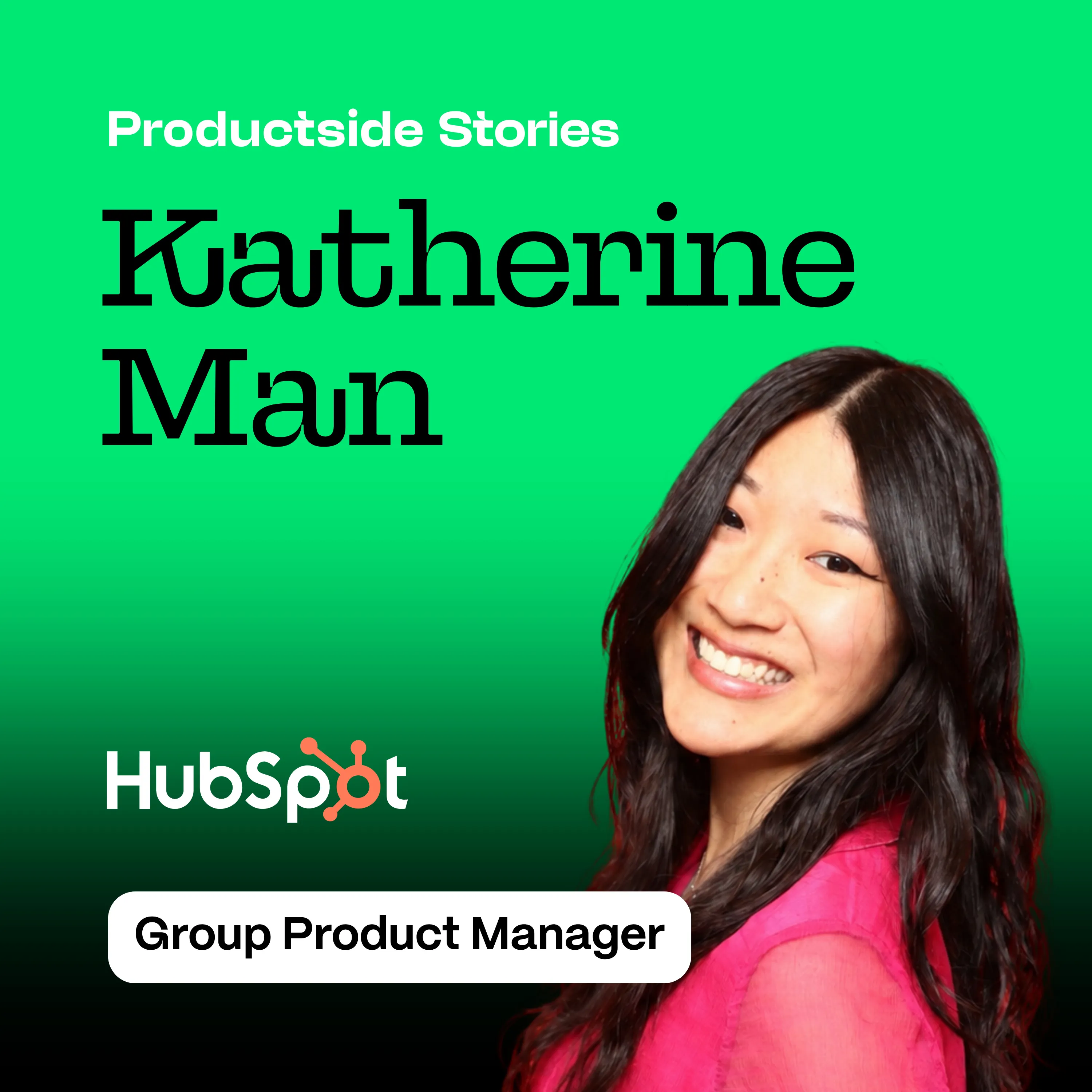
Katherine Mann, group product manager at HubSpot, explores how AI has democratized routine product management tasks, leaving core complex decisions intact, and evaluates AI’s real ROI through customer outcomes rather than speed metrics alone. She highlights new challenges in skill development and trust-building with AI adoption.
In their own words
“AI has democratized the bottom 10% of your job, the simplest part, but the other 90% that makes someone actually good is more exposed than ever.”
- Katherine Mann · 6:00
“AI has killed the excuse culture. No PM on the team? AI is your PM. No designer? You have prototyping tools.”
- Katherine Mann · 13:00
Key takeaways
- AI has democratized the bottom 10% of product management work involving simple tasks, while the remaining 90% requiring nuanced judgment remains essential and exposed, says Katherine Mann. (6:00)
- Product, design, and engineering roles have not disappeared but expanded and overlapped, improving collaboration and conversations rather than merging into fewer roles. (5:00)
- Junior product managers and designers face a skill-building gap as AI automates grunt work traditionally used to develop judgment, posing a 2-5 year talent development challenge. (10:00)
- AI accelerates work velocity significantly - HubSpot engineers experienced a 60% increase in shipping speed and complex projects occur about four times faster - but quality systems lag behind velocity gains. (15:00)
- True AI ROI must be measured through business outcomes like an 80% increase in meetings booked and 2.3x improvement in customer support resolution rates, rather than adoption or productivity metrics alone. (17:30)
- AI fills gaps on underresourced teams by performing PM and design tasks, but human judgment is still required for complex prioritization and trade-offs. (13:00)
- Trust is a major challenge; customers worry about data ownership and prefer transparency, prompting HubSpot to cite AI sources, explain logic, and allow customizable AI prompts to build confidence. (18:00)
- Katherine’s own experience shows AI confidence can overstep real user needs, illustrating the importance of trusting specialized team members despite AI assistance. (6:30)
90 minutes of unfiltered product advice from Snap and Discord’s product chief | Peter Sellis
Lenny’s Podcast: Product | Career | Growth · 21 September 2026 | 1:36:53

Peter Sellis shares contrarian product leadership lessons from Snapchat and Discord, emphasizing ruthless focus on core user growth, managing spiky talent, developing refined product taste, and embracing ambitious, mission-driven cultures to drive sustainable innovation and monetization.
In their own words
“You like to design teams like a terrorist organization.”
- Peter Sellis · 2:48
“Most product managers are bad and are often net negative to the company.”
- Peter Sellis · 12:20
Key takeaways
- Design teams like terrorist organizations by building a strong ideological culture and clear decision-making authority, enabling rapid execution without costly collaboration overhead. (2:48)
- Most product managers are mediocre or net negative; the best PMs tend to leave to become founders or executives, skewing the profession’s median quality downward. (12:20)
- Product managers must develop strong taste and practice saying no to AI-driven feature suggestions to maintain product simplicity and quality. (41:50)
- Snapchat’s ad monetization faced challenges due to its predominantly young user base and non-feed, creation-oriented core experience, constraining traditional ad formats and targeting. (23:20)
- Riding your best performers hard by giving them more autonomy and responsibility until they err is more effective than trying to fix weaker team members. (46:20)
- Growth almost always comes from optimizing engagement of your core product and user base, e.g., moving users from 10 to 12-13 active days per month can drive ‘monster’ growth. (46:40)
- SpaceX’s ‘burn the ships’ strategy - intentionally obsoleting their Falcon 9 to prioritize Starship development - exemplifies bold long-term vision and mission alignment overcoming innovator’s dilemma. (58:20)
- A great PM embodies oxymorons: confident yet humble, highly organized yet comfortable with ambiguity, and blends long-term vision with a relentless bias for immediate action. (1:20:00)
Hinge CPTO on Building an App Designed to Be Deleted, Merging the CPO and CTO Roles, Chasing $1B in Revenue Without Chasing Engagement | Ben Celebicic | E312
The Product Podcast · 17 September 2026 | 26:15

Ben Celebicic, CPTO at Hinge, explains how the dating app’s product strategy centers on creating great real-life dates rather than maximizing engagement, while leveraging AI to personalize experiences and cautiously integrating AI in development. He also outlines Hinge’s unique monetization model and growth ambitions toward $1 billion revenue by 2027.
In their own words
“Hinge’s North Star metric is great dates, not user engagement. We optimize for users to leave the app after finding success.”
- Ben Celebicic
“Trust and safety make up roughly one third of our entire organization, reflecting how critical authenticity and user protection are for dating success.”
- Ben Celebicic
Key takeaways
- Hinge’s North Star is optimizing for great real-life dates that get users off the app, not maximizing time spent or engagement metrics, challenging industry norms.
- Ben manages the combined CPO and CTO role by balancing the tension between rapid innovation and protecting technical quality and infrastructure within a nearly 300-person team. (2:30)
- Hinge’s monetization philosophy charges less than 15% of users and focuses on features that cannot be freely given without breaking the ecosystem, preserving a robust free experience. (8:30)
- Trust and safety is a core priority, constituting about one third of Hinge’s workforce, with extensive use of AI and machine learning to detect fake profiles and protect user authenticity.
- Generative AI now powers personalized profile coaching and scalable, behavior-based user experiences that were impossible before, improving individual dating success.
- AI accelerates product feedback loops, enabling rapid prototyping without engineers and allowing product managers to generate visual prototypes directly from specifications. (19:30)
- Despite advances, Ben retains a conservative view on non-engineers shipping code, requiring proof of scalable, maintainable technology before allowing product managers or designers to modify codebases. (22:00)
- Hinge aims to achieve $1 billion in revenue by 2027, focusing on obsessing over user needs and building features that solve core dating problems with a clean, simple product. (15:00)
What is AI product management, really? Jonathan Evens (AI Product Lead, Google DeepMind)
The Product Experience: a Mind the Product podcast · 16 September 2026 | 42:37
Jonathan Evens, AI Product Lead at Google DeepMind, clarifies that “AI product manager” actually denotes two distinct roles focused on core model capabilities and AI-powered feature development respectively. He emphasizes prioritizing product principles and user empathy over AI technology itself to build trustworthy, impactful AI products.
In their own words
“Using an LLM as a thinking partner or coding assistant does not make you an AI product manager, it makes you a product manager using AI as a tool.”
- Jonathan Evens · 11:30
“Product principles, not evaluations, are the real starting point for any AI feature.”
- Jonathan Evens · 18:00
Key takeaways
- The label ‘AI product manager’ conflates two distinct roles: modeling product managers in frontier labs focused on core AI capabilities and feature product managers who build AI-powered products using existing models, requiring domain expertise and user empathy more than deep technical skill. (6:30)
- Using AI tools like large language models for coding or ideation does not make one an AI product manager; it means they are product managers employing AI as a productivity tool similar to any other knowledge work aid. (11:30)
- AI feature product managers must focus on designing user experiences that leverage roughly 80% of existing model capabilities while tuning the last 20% to fit specific use cases effectively, relying heavily on domain knowledge. (11:00)
- Product principles must guide AI feature development and evaluation - defining the intended experience and values precedes building any metric or evaluation set, as exemplified by Google Search’s approach to managing trust amid conflicting sources and model hallucinations. (18:00)
- Trust in AI features is built through transparent sourcing and thoughtful UX design, such as Google Search’s AI Overviews using reliable document citations and visual cues allowing users to quickly assess information credibility. (30:30)
- Synthetic users provide crucial value in cold-start scenarios, privacy-sensitive studies, and automated regression testing by simulating edge cases and measuring capability changes, yet they remain less diverse and more extreme than real people, limiting their representativeness. (25:30)
- Team structures for AI product development vary widely: some problems need only a senior developer with AI tools, while complex challenges like a digital citizenry sandbox require interdisciplinary teams and principled approaches; no single team size fits all. (33:30)
- As engineers increasingly handle evaluation work through iterative prompting, the AI product manager’s role shifts toward making judgment calls rooted in product principles, distinguishing which technical trade-offs truly impact user value versus those easiest to measure. (35:30)
How AI Is Changing Product Management
Productside Stories · 16 September 2026 | 30:13 | S5 E2

Advaita Nigudkar, Director of Product Management at BILL, explores how AI is transforming product management by automating routine tasks and raising quality standards, while emphasizing the irreplaceable human elements that ensure effective product differentiation and customer focus. She highlights challenges and best practices integrating AI within regulated financial environments.
In their own words
“Curiosity is one of the things that sets PMs apart, and I feel like, try not to lose that as a quality for each one of you.”
- Advaita Nigudkar · 29:30
Key takeaways
- AI accelerates routine PM tasks such as data analysis and prototyping but requires PMs to provide rich, domain-specific context - like customer personas and product variants - to generate relevant outputs beyond simplistic admin use cases.
- Advaita’s team developed AI ‘skills’ and templates prompting PM input on customers, SKUs, and partners to improve AI-generated product requirement documents (PRDs), reducing iterations and enhancing quality and consistency.
- Deploying large language models as judges to assess AI-generated PRDs against high-quality past examples helps maintain consistent standards and reveals missing content, which PMs then supply before AI refines the document.
- In regulated contexts where AI agents manage sensitive actions like money movement, transparency through audit logs, user controls, and encryption builds crucial customer trust and aligns with risk-based usage patterns.
- Core human PM skills including customer obsession, negotiation, prioritization, and cross-functional collaboration remain essential and irreplaceable by AI to avoid product sameness and to solve the right problems.
- Advaita warns PMs against losing curiosity by over-relying on AI outputs, emphasizing that curiosity differentiates good product managers who use AI as a helper rather than a replacement.
- Advaita envisions AI assisting with complex multi-team workflows, negotiations, and reducing cross-time-zone frictions, though it remains an unsolved challenge.
Bolt CEO on Turning AI Prototypes Into Production Code Engineers Trust, the Story Behind a 5M-to-20M ARR Ramp in Two Months | Eric Simons | E311
The Product Podcast · 10 September 2026 | 31:46

Eric Simons, CEO of StackBlitz and Bolt, reveals how a near-shutdown pivot to an AI-powered web development platform led to unprecedented ARR growth from $0.5M to $20M in two months. He emphasizes focus on professional product builders, deep integrations for production-ready AI code, and transformative pricing innovations in SaaS.
In their own words
“The best advice is don’t die.”
- Eric Simons · 4:30
“There’s only 2 ways to make money in software: bundling and unbundling.”
- Anonymous Netscape CEO quoted by Eric Simons · 19:30
Key takeaways
- Bolt’s WebContainer OS enables full-stack app development entirely in-browser using WebAssembly, eliminating traditional downloads and supporting production-ready code deployment. (7:00)
- One month before being shut down, StackBlitz launched Bolt, acquiring tens of thousands of paying customers rapidly, scalable to $20M ARR with just about 12 engineers within two months.
- Bolt targets professional product builders - product managers, designers, and engineers - focusing deeply on their workflows instead of a broad consumer approach, analogous to how ChatGPT and Anthropic split AI markets.
- Bolt has built seamless integration to convert AI-generated prototypes into production code that engineering teams trust and can directly deploy, overcoming a core industry challenge.
- Bolt pioneered aggressive usage-based pricing within 72 hours of launch, setting a new standard for AI products that correlates customer cost with actual value and usage rather than per-seat licenses.
- The SaaS market is undergoing a significant transition from flawed seat-based pricing to value-based models driven by AI adoption and usage data, with incumbents under margin pressure to adapt rapidly.
- Open source AI models and open weights are vital for global innovation and affordability; exclusionary geopolitics harm progress, and participation in open models is less risky than abstention for companies.
Product and Design Collaboration: AI Can’t Judge
Productside Stories · 10 September 2026 | 32:39 | S5 E1

Jared Hall-Dugas, lead UX designer at National Grid, reveals that while AI accelerates prototyping and changes team roles, human judgment in design selection and early collaboration remains indispensable to avoid costly rewrites and maintain quality - especially in regulated industries.
In their own words
“Designers and product managers are just as scared and just as worried about their job roles and the future as product managers are; we are doing the job together.”
- Jared Hall-Dugas · 30:30
Key takeaways
- AI accelerates prototyping roughly tenfold and empowers all roles - designers, product managers, and engineers - to create faster, reshaping expectations for each role’s contributions.
- Human judgment is irreplaceable; AI cannot yet determine which of multiple AI-generated prototypes will succeed or explain why, preserving a critical role for design and product professionals.
- AI-generated prototypes often look polished but contain non-functional elements and inaccurate data, creating a ‘Pinocchio effect’ where appearances deceive and expert review is crucial.
- Cutting design involvement at the convergence of discovery into solution definition leads to expensive rewrites; design inclusion from day one prevents misdirection and costly rework.
- Designers serve as ‘chiefs of staff’ to product managers, questioning assumptions and aligning collaboration early through methods like vibe prototyping to clarify problems and improve outcomes.
- In large regulated organizations, AI adoption requires deliberate cross-team conversations about roles, security, and responsibilities; visible successes and engineering oversight are needed to manage risks and cultural resistance.
- The evolving AI landscape demands redefining team roles through openness and joint problem-solving, not replacement; all parties share uncertainty and must champion collaboration to leverage AI effectively.
What I learned from building, and exiting a startup — Kirsten Mann (Strategic Advisor)
The Product Experience: a Mind the Product podcast · 9 September 2026 | 51:36
Kirsten Mann, board director and product leader, shares insights from building and exiting the AI-based startup Vizory. She emphasizes that distribution and adoption challenges, not product build speed or AI capability, are the primary obstacles for AI startups today.
In their own words
“Distribution is the product problem right now.”
- Kirsten Mann · 41:00
“Testing to fail is better than testing to confirm you’re right.”
- Kirsten Mann · 16:30
Key takeaways
- Distribution is currently the biggest product problem; AI lowers building costs but does not reduce the difficulty or cost of reaching customers who trust you, making adoption and willingness to pay critical factors alongside product quality. (0:30)
- Before writing code, Mann rigorously tested demand by obtaining confidential board packs and audio recordings from real directors, using friction deliberately (e.g., charging early, requiring sensitive data) to filter genuine interest from polite enthusiasm. (17:00)
- Despite strong demo reactions, actual user behavior showed divergence between stated and revealed preferences; e.g., a heavily demoed cross-pack search feature was rarely used because users prioritized automated triage views that saved time. (22:30)
- Board directors operate on quarterly cycles requiring about three cycles (close to a year) to fully trust and adopt new tools, a timeline that far exceeds typical SaaS trial periods and requires patience in value realization. (16:00)
- Pricing Vizory faced anchoring challenges: users compared pricing both to low-cost AI tools like ChatGPT and internal benchmarks, leading to perceived steep price increases that complicated scaling pilots into full pricing. (36:00)
- AI models used in Vizory could be deprecated suddenly without warning, causing operational risks; continuous monitoring, evaluation, and QA are necessary post-launch, treating AI components like employees needing regular performance review. (47:30)
- Founders often test to confirm their ideas rather than to invalidate them; Mann advocates for tests designed to find reasons to stop early, saving resources and avoiding building products without real market demand. (16:30)
- Being your own customer helps understand problems deeply but can mislead because it is the least reliable source for broad market demand signals; true validation must go beyond personal conviction and focus on customer jobs to be done. (9:30)
How we built Grok Bot in a month | Roman Ugarte (SpaceXAI)
Lenny’s Podcast: Product | Career | Growth · 9 September 2026 | 1:22:43

GrokBot was developed by a small, focused internal team over about one month to create an AI agent that acts as a teammate for knowledge work beyond software development. The product emphasizes cloud-based, persistent AI agents with dedicated virtual ‘computers’ for task execution via pixel-level UI interaction rather than relying exclusively on APIs. Early internal launch showed strong adoption and user enthusiasm, including tool transitions from ChatGPT. GrokBot aims for broad applicability across work and personal life by maintaining a team-of-bots approach that supports complex automations with minimal micromanagement.
Key takeaways
- GrokBot aims to be an AI team that helps with both work and life, focusing on knowledge work beyond just developers and engineers.
- The product was built by a small, isolated internal team working intensely for about a month, enabling fast iteration and decision-making. (0:43)
- Internal launch was highly successful with many users transitioning from ChatGPT to GrokBot as their primary agent. (1:15)
- A separate product was chosen over adding AI features to existing coding tools to provide a simpler, bot-native experience for non-technical users. (1:58)
- Manual onboarding of 200-300 early users was critical for iterative learning; onboarding sessions involved close troubleshooting and rapid fixes. (11:15)
- GrokBot bots run persistently in the cloud with dedicated virtual ‘computers’ that interact with UI pixels, avoiding pitfalls of API-only or device-tethered bots. (22:43)
- User interfaces abstract internal complexity to reduce cognitive load, e.g., showing minimal updates instead of verbose chain-of-thought details, as per user preference. (12:00)
- GrokBot agents maintain persistent context (long-term memory) and can act autonomously on delegated tasks, enabling a shift from iterative assistance to ‘no-look passes’ to AI teammates. (45:35)
Why companies are becoming a series of loops | Anish Acharya (a16z)
Lenny’s Podcast: Product | Career | Growth · 7 September 2026 | 1:19:24

Companies increasingly structure operations as interconnected, AI-augmented loops that automate repetitive tasks while humans focus on strategic innovation and intuition. This loop-centric approach transforms product development, go-to-market, and growth, while AI-driven distribution and moats emerge from sustained engagement and remarkable user experiences.
In their own words
“We’re on the slow takeoff scenario.”
- Anish Acharya · 5:50
“Two years of roadmap happens in three months.”
- Anish Acharya · 13:30
Key takeaways
- The fear that AI will create a ‘permanent underclass’ lacks data support; technology access, distributed opportunities, and independent company success are growing.
- Companies build as a series of loops where AI agents handle coding, marketing, sales, and legal tasks autonomously, compressing years of work into months, enhancing execution speed. (10:46)
- Human intuition remains indispensable for out-of-distribution thinking, strategic innovation, and unblocking AI agents stuck on knowledge gaps - revealing a symbiotic human-AI workflow. (11:15)
- Go-to-market teams use AI disproportionately for administrative and operational tasks, freeing humans to excel at closing deals and high-value work; OpenAI’s sales team reportedly uses Codex more than engineers do. (12:00)
- Shifting product management from ‘saying no’ to ideas towards ‘saying yes’ and simulating user reactions enables experimentation at scale, validating many product variations rapidly and fostering organizational health. (11:15)
- Moats in AI are discovered over time, not designed upfront; product quality, user experience, momentum, and distribution drive durable advantages more than technological uniqueness alone. (51:50)
- Distribution through organic word-of-mouth and social sharing is now the primary moat for AI products, since large platforms protect networks and limit new network formation. (51:50)
- The biggest consumer AI opportunities are in building loops to enhance happiness, health, and emotional connection beyond productivity - addressing a current ‘spiritual hunger’ unfulfilled by tech. (31:16)
Anthropic Member of Technical Staff on Leading Forward-Deployed Engineers, Turning Down 2x Pay, and Why Leaders Are Becoming ICs Again | Amandeep Khurana | E310
The Product Podcast · 3 September 2026 | 25:56

Amandeep Khurana, Member of Technical Staff at Anthropic leading forward-deployed engineering, shares his deliberate choice of hands-on roles over management to foster learning, how Anthropic’s forward deployed engineering uniquely integrates with clients, and why mission alignment outweighs higher pay offers in AI talent retention.
In their own words
“If AI is to play out all the benefits, the talent, especially on the applied side, has to be taken to the market and there needs to be diffusion.”
- Amandeep Khurana · 19:00
“Freedom to choose your own game or what success looks like, rather than following predefined structures, is a powerful career insight.”
- Amandeep Khurana · 22:30
Key takeaways
- Amandeep Khurana intentionally stepped back from a management role at Amazon in 2023 to return to an individual contributor position in AI to deepen his hands-on expertise rather than manage teams. (5:00)
- Anthropic’s forward deployed engineering (FDE) function is distinct from traditional professional services by deeply aligning with client outcomes, owning solution journeys, and producing reusable playbooks that feed back into products and research. (8:00)
- FDE engagements at Anthropic are chosen primarily for strategic fit - mission alignment, novelty, new use cases, and product insight opportunities - not principally for direct financial gain. (13:30)
- Despite offers paying two to three times more at other frontier AI labs, Anthropic retains talent with a culture emphasizing mission alignment, shared principles, and a non-hierarchical structure where everyone is a Member of Technical Staff focused on contribution over status. (16:00)
- Amandeep advocates that AI’s benefits require widespread diffusion of talent and applied AI expertise across the market, paralleling historical tech trends of lowering cost and increasing accessibility through training, tooling, and open models. (19:00)
- Amandeep challenges conventional career progression norms by choosing personal fulfillment (‘heart’) over climbing management ranks, emphasizing freedom to define career success beyond company hierarchies and societal expectations. (21:00)
- The MTS title culture at Anthropic removes hierarchical authority, fostering equality based on ideas and allowing individuals to self-select into a meritocratic, collaborative environment. (24:00)
How to position your product for a future nobody can predict - April Dunford (Author of Obviously Awesome)
The Product Experience: a Mind the Product podcast · 2 September 2026 | 37:50
April Dunford, a positioning expert and author of Obviously Awesome, explains how companies must define a clear, credible vision of their product’s future to navigate unpredictable markets like AI-driven change. She highlights positioning as a cross-functional effort impacting product, pricing, and sales strategy, not just marketing.
In their own words
“You’ve got to decide, like, you’re making a bet right now. Your product team is building a bunch of stuff, right? And you’ve got a vision of where this thing goes, and you’ve got a product roadmap that’s going somewhere. You’ve planted a flag whether you want to or not.”
- Lily Smith · 0:30
“Models are only as good as the context you feed them about your business and your processes and what’s going on in there.”
- Satya Nadella (quoted by April Dunford) · 16:00
Key takeaways
- Positioning defines how a product excels at delivering unique value to a specific customer segment and sets context for understanding even brand-new products, emphasizing it is not merely a marketing exercise but influences product development and sales strategy.
- Massive shifts such as COVID-19, cloud migration, and especially AI cause companies to reposition widely because customer needs and competitive landscapes become uncertain, which challenges companies to decide which competitors and markets to target.
- Intercom’s AI-driven support product redesign centered on the customer’s fundamental job of resolving tickets, illustrating that focus on customer outcomes anchors effective product and pricing strategies in AI transformations.
- A compelling, credible point of view on the future is critical to prevent customers from freezing purchasing decisions amid uncertainty; this vision must arise from genuine differentiated strengths, not opportunistic hype, to build trust and motivate early adoption.
- Overhyping future product features can stall sales because customers delay purchases awaiting promised capabilities; thus, companies need a maturity model showing a low-risk, stepwise path from today’s solutions to the future market.
- Positioning should be reviewed systematically every six months through structured processes identifying competitors, differentiators, and value themes, supported by customer advisory boards, executive account calls, and sales team insights to detect shifts before lost deals occur.
- Sales teams act as an early warning system for competitive shifts and changing customer behaviors, but companies often fail to gather insights until deal losses indicate problem areas, highlighting the need for proactive, systematic information flows. (34:00)
AI’s third era: the rise of persistent AI coworkers | Tara Seshan (Product Lead ChatGPT Work)
Lenny’s Podcast: Product | Career | Growth · 31 August 2026 | 1:21:44

Tara Seshan, product lead for Codex and ChatGPT Work at OpenAI, discusses the emerging third era of AI characterized by persistent AI coworkers that collaborate deeply with humans. She emphasizes rapid empirical iteration, the shift from executing to steering work, and elevating human ambition as critical for future AI product success.
In their own words
“At OpenAI, everyone inside the company, especially in their area, is in essence kind of a founder to some extent.”
- Tara Seshan · 3:30
“Is this maximally accelerated? Are you mainlining it yet?”
- Tara Seshan · 25:00
Key takeaways
- Building AI products requires focusing on model capabilities 2 to 3 months ahead; planning for current or year-ahead models leads to failure due to rapid AI progress (Tara Seshan).
- In fast-evolving AI markets, rapid empirical testing and prolific iteration outweigh grand theoretical planning for product success (Tara Seshan). (0:30)
- OpenAI’s culture treats all employees as founders, minimizing top-down direction and enabling close alignment with user needs and fast product iteration (Tara Seshan).
- Knowledge work is shifting from manual execution (‘rowing’) to high-level steering - guiding autonomous AI agents collaboratively, which requires distinctly human judgment and vision (Tara Seshan).
- AI agents need appropriate access to internal data and cloud infrastructure to function as true persistent coworkers integrated into organizational workflows (Tara Seshan).
- Human ambition is now the key differentiator in knowledge work because AI lowers barriers for routine tasks; product managers must actively raise team ambitions to harness AI’s potential (Tara Seshan).
- OpenAI is working toward seamless integration of Codex and ChatGPT, aiming for a unified super app where the AI selects the optimal model for user tasks without user choice (Tara Seshan).
- Writing serves two distinct purposes: ‘writing as thinking’ (idea development) is best done by humans to refine concepts, while ‘writing as reporting’ can be heavily automated with AI (Tara Seshan).
- AI products succeed by shipping early, iterating rapidly with user feedback, and relying on human initiative and obsession with user experience rather than relying solely on AI capabilities (Tara Seshan).